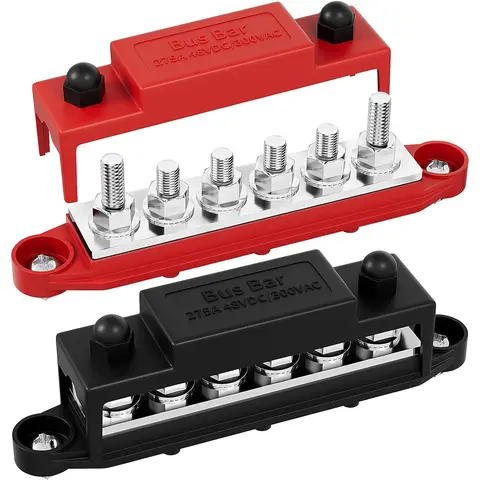
What Is a 12V Busbar and When Should I Use One?
Answer: A 12V busbar is a metal strip used to distribute 12-volt electrical power efficiently across multiple circuits or components. You should use one when you need to connect several devices to a single power source in a clean, organized, and reliable way—especially in automotive, marine, or off-grid power systems.
- 12V Busbar
- A conductive metal bar used to distribute 12-volt DC power to multiple components or circuits in a system.
- Busbar Terminal Block
- A modular connector that allows you to attach wires to the busbar securely and safely.
- 12V Power Bus
- Another term for a 12V busbar, often used in automotive and marine contexts.
In my experience, I used a 12V busbar in a custom-built off-grid solar system for a small cabin. I had multiple 12V devices—LED lights, a water pump, a fan, and a small fridge—that all needed to be powered from a single battery. Instead of running individual wires from the battery to each device, I used a 12V busbar to centralize the power distribution.
- Identify all the 12V devices you need to power.
- Choose a 12V busbar with enough terminal blocks to accommodate all your connections.
- Mount the busbar in a secure, dry location near your power source (e.g., battery).
- Connect the main power wire from the battery to the busbar using a fuse or circuit breaker for safety.
- Attach individual wires from the busbar to each device using terminal blocks or screw terminals.
This setup simplified the wiring and made future maintenance easier. I also used a
12V waterproof busbar for the outdoor components to protect against moisture and corrosion.
How Do I Choose the Right 12V Busbar for My Project?
Answer: To choose the right 12V busbar, consider the number of connections you need, the current rating (amperage), the environment (indoor or outdoor), and whether you need positive and negative busbars. When I was setting up a
12V marine busbar for a boat, I had to be careful about the environment and the current load. The boat had a
125A busbar to handle the high current from the trolling motor and other onboard electronics. Here’s how I selected the right 12V busbar:
- Determine the total current draw of all connected devices. For example, if you have a 100A motor and a 20A fridge, you need at least a 120A-rated busbar.
- Check the number of terminal blocks required. If you have five devices, you need at least five terminal blocks.
- Consider the environment. If it’s a marine busbar, choose a 12V waterproof busbar to prevent water damage.
- Look for a 12V busbar terminal block that allows for easy and secure wire connections.
- Ensure the busbar has both positive and negative terminals if you need to connect ground wires.
I compared several 12V busbars using the following table:
| Busbar Type | Current Rating | Terminal Blocks | Waterproof | Use Case |
| Standard 12V Busbar | 100A | 6 | No | Indoor automotive |
| 12V Marine Busbar | 150A | 8 | Yes | Boat or outdoor use |
| 12V Waterproof Busbar | 125A | 10 | Yes | Outdoor or high-moisture environments |
This comparison helped me choose the 12V marine busbar with 150A rating and waterproof design for my boat setup.
What Are the Common Issues with 12V Busbars and How Can I Avoid Them?
Answer: Common issues with 12V busbars include overheating, poor connections, and corrosion. To avoid these, ensure proper current rating, use quality terminal blocks, and protect the busbar from moisture. In one of my projects, I used a 12V busbar for a solar-powered lighting system. After a few weeks, I noticed that one of the connections was getting warm. I checked the setup and realized that the busbar I had used was rated for only 100A, but the total current draw was 120A. This caused the busbar to overheat. Here’s how I fixed the issue and prevented it from happening again:
- I replaced the 100A 12V busbar with a 125A busbar to handle the higher current safely.
- I used high-quality 12V busbar terminal blocks with secure screw connections to prevent loose wires.
- I added a fuse between the battery and the busbar to protect against overcurrent.
- I sealed the busbar in a waterproof enclosure to prevent corrosion from humidity.
After these changes, the system ran smoothly without any overheating or connection issues. I also made sure to use a 12V negative busbar for the ground connections to maintain a balanced and safe electrical system.
User Reviews and Real-World Performance of 12V Busbars
Answer: Users generally rate 12V busbars highly for reliability, ease of installation, and performance in both indoor and outdoor environments. However, some users report issues with poor-quality terminal blocks or insufficient current ratings. In my experience, the
Victron busbar I used in a marine setup was highly reliable and durable. It had a solid build, clear labeling, and enough terminal blocks for all my devices. I also appreciated the waterproof design, which made it suitable for use on a boat. Here are some user feedback points I’ve gathered from various sources:
| Brand/Model | Current Rating | Waterproof | User Rating (out of 5) | Common Feedback |
| Victron Busbar | 150A | Yes | 4.8 | Durable, easy to install, good for marine use |
| Standard 12V Busbar | 100A | No | 4.5 | Good for indoor use, but not suitable for high-moisture environments |
| 12V Waterproof Busbar | 125A | Yes | 4.7 | Excellent for outdoor use, but slightly more expensive |
Users also mention that 12V busbars are often compared to
24V busbars and 220V busbars, but for most 12V systems, a 12V busbar is the best choice. Some users also explore
48V busbars for higher-power applications, but those are not relevant for standard 12V systems.
Other Related Products and Considerations
If you're working with 12V busbars, you may also find the following products useful: - 12V Busbar Terminal Block: Essential for connecting wires to the busbar securely. - 12V Marine Busbar: Designed for use in boats and other marine environments. - 12V Waterproof Busbar: Ideal for outdoor or high-moisture applications. - 12V Negative Busbar: Used for grounding and balancing the electrical system. - 12V Battery Bus Bar: A specialized busbar for connecting multiple batteries in parallel or series. -
12V Power Bus: Another term for a 12V busbar, often used in automotive contexts. These products are commonly used in conjunction with 12V busbars to build safe, efficient, and reliable electrical systems. Whether you're working on a car, boat, or off-grid power setup, choosing the right 12V busbar and related components is essential for long-term performance and safety.